Syria Reconstruction: The Scale of Opportunity
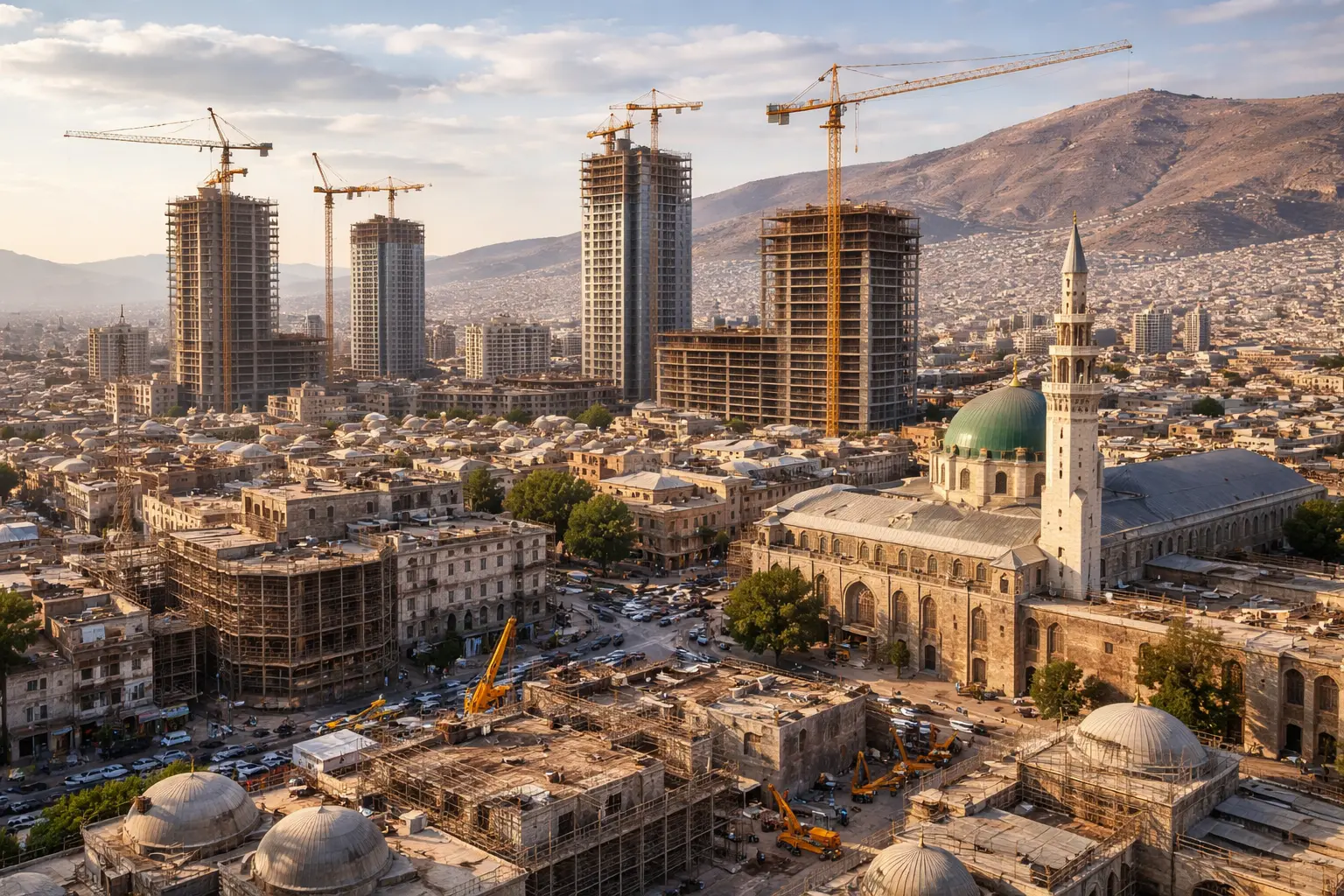
Syria's rebuilding represents one of the largest reconstruction efforts in modern history. The World Bank estimates total reconstruction needs at approximately $216 billion, while the UN Economic and Social Commission for Western Asia (ESCWA) calculates cumulative GDP losses at $510-540 billion from 2011-2023. This creates unprecedented opportunities for construction companies, contractors, and infrastructure investors.
Following the December 2024 political transition and subsequent sanctions relief, international participation in Syria's reconstruction has accelerated. Brussels IX donors pledged approximately 5.8 billion euros in February 2025, while bilateral agreements with GCC states, China, and Turkey are channeling additional investment into infrastructure projects.
Foreign Investor Entry: Legal Framework
Investment Law Decree 114 of 2025 opened Syria's construction sector to full foreign participation. Unlike many regional markets requiring local partnership, Syria permits 100% foreign ownership of construction companies and contractor entities. This creates direct market entry options for international construction firms.
Investment Law Benefits for Construction
- 100% Foreign Ownership: No mandatory Syrian partner requirement for construction companies
- Tax Incentives: 50-75% income tax exemption for 10 years; projects in reconstruction zones receive highest tier
- Customs Exemption: Complete duty exemption on equipment, machinery, and construction materials imported for registered projects
- Profit Repatriation: Guaranteed right to repatriate profits in foreign currency after tax obligations
- Land Access: Facilitated land allocation in development zones and reconstruction areas
- Fast-Track Licensing: Syria Investment Commission review within 15 days
In our experience, projects registered with the Syria Investment Commission receive priority treatment across all government agencies. We strongly recommend investment registration before company formation to maximize incentive eligibility.
Company Formation Options
Foreign contractors can establish Syrian operations through several legal structures. The optimal choice depends on project scope, duration, and participation in public tenders.
| Structure | Timeline | Capital Requirement | Best For |
|---|---|---|---|
| Limited Liability Company (LLC) | 15-21 days | 50M SYP (~$4,000) | Long-term operations, public tenders |
| Joint Stock Company | 4-6 weeks | 100M SYP (~$8,000) | Large projects, major BOT participation |
| Foreign Branch | 6-10 weeks | 10M SYP (~$800) | Specific projects, representative presence |
| Joint Venture | Variable | Variable | Partnering with Syrian contractors |
Entering Syria's Construction Market?
Our team handles complete company formation and contractor licensing for foreign construction firms.
Contractor Classification System
Syria's contractor classification system (Decree 18/2019) determines which projects a company can bid on. Classification is mandatory for public tender participation and influences private sector credibility. The Ministry of Public Works and Housing administers the system.
Classification Grades
| Grade | Maximum Project Value | Requirements |
|---|---|---|
| First Class | Unlimited | Highest technical capacity, equipment, and financial strength |
| Second Class | 500M SYP | Substantial equipment, qualified engineers, proven track record |
| Third Class | 200M SYP | Moderate equipment, technical staff, financial capability |
| Fourth Class | 50M SYP | Basic equipment, registered engineers |
| Fifth Class | 10M SYP | Entry level, minimal requirements |
Classification Process
- Application Submission: File with Ministry of Public Works including company registration, technical capacity documentation, and equipment inventory
- Personnel Verification: Engineers must be registered with Syrian Engineers Syndicate; submit qualifications and experience records
- Equipment Inspection: Ministry officials inspect declared equipment for operational condition
- Financial Review: Submit audited financials demonstrating capital adequacy for target classification
- Classification Issuance: Approval and classification certificate valid for specified period (typically 2-3 years)
Foreign contractors can leverage parent company credentials for initial classification. We coordinate documentation between home country and Syrian authorities to expedite classification approval for established international firms.
Major Reconstruction Projects
Several flagship projects demonstrate the scale of reconstruction opportunities available to qualified contractors.
Damascus International Airport
BOT contract awarded to Damascus Cham Wings consortium (March 2025). Terminal modernization, runway rehabilitation, cargo facilities.
Power Generation & Grid
UCC Consortium 4,000 MW CCGT + 1,000 MW solar. ACWA Power 2.5 GW renewable agreement. Grid rehabilitation nationwide.
Housing Reconstruction
400,000 destroyed units, 1.2 million damaged. Social housing programs, urban redevelopment, Marota City completion.
Road & Transport Network
22,500 km road network rehabilitation. M5 Damascus-Aleppo highway. Rail network restoration. Port infrastructure.
Contract Standards: FIDIC in Syria
Syria employs FIDIC (Federation Internationale des Ingenieurs-Conseils) contract standards for major construction projects, particularly those involving international financing or foreign contractors. Understanding FIDIC adaptation to Syrian law is essential for contract negotiation.
Common FIDIC Forms in Syria
- Red Book (Construction): Traditional employer-designed projects with contractor execution. Most common for public infrastructure.
- Yellow Book (Design-Build): Contractor responsible for design and construction. Used for specialized facilities.
- Silver Book (EPC/Turnkey): Single-point responsibility for engineering, procurement, and construction. Common for power plants and industrial facilities.
Syrian Law Adaptations
Standard FIDIC contracts require modification for Syrian jurisdiction. Key adaptations include:
- Governing law clause specifying Syrian Civil Code
- Dispute resolution through Syrian Commercial Arbitration or specified international forum
- Currency provisions addressing SYP/USD/EUR payment structures
- Force majeure definitions aligned with Syrian legal concepts
- Performance guarantee requirements per Ministry of Finance regulations
Need FIDIC Contract Drafting?
Our construction law team drafts and reviews FIDIC contracts adapted to Syrian legal requirements.
Public Procurement: Tender Participation
Public Procurement Law 51/2004 governs government tender processes. Participation requires contractor classification, proper registration, and compliance with tender documentation requirements.
Tender Process Overview
- Prequalification: Submit company credentials, financial statements, and project experience for evaluation
- Tender Document Acquisition: Purchase or obtain tender documents from procuring ministry
- Bid Preparation: Prepare technical and financial proposals per specifications
- Bid Bond Submission: Provide bank guarantee (typically 2-5% of bid value) from Syrian-licensed bank
- Bid Submission: Submit sealed proposals before deadline
- Evaluation: Technical evaluation followed by financial comparison
- Award: Contract award to lowest qualified bidder (price preference for technical quality in some tenders)
Bid bonds must typically be issued by Syrian banks or banks with Syrian correspondent relationships. Foreign contractors should establish banking relationships before tender participation. We assist with introductions to appropriate financial institutions.
BOT and PPP Opportunities
Build-Operate-Transfer (BOT) and Public-Private Partnership (PPP) projects offer extended investment horizons with revenue-generating operations. Syria has awarded several major BOT contracts following 2025 reforms.
BOT Project Structure
- Concession Period: Typically 25-30 years for major infrastructure
- Investment Recovery: Through user fees, government availability payments, or hybrid models
- Project Company: Special purpose vehicle (SPV) established in Syria to hold concession
- Financing: Project finance structures with limited recourse to sponsors
Damascus Airport BOT Case Study
The $4 billion Damascus International Airport modernization, awarded to Damascus Cham Wings consortium in March 2025, demonstrates BOT structuring in practice. The project includes terminal expansion, runway rehabilitation, cargo facilities, and commercial development, with recovery through airport operation revenues over the concession period.
Our Legal Services for Construction Clients
Al Arabia Law provides comprehensive legal support for construction sector market entry and project execution. Our experience includes advising contractors, developers, and infrastructure investors on Syrian operations.
Market Entry Services
- Investment registration with Syria Investment Commission
- Construction company formation (LLC, joint stock, branch)
- Contractor classification applications
- Engineers Syndicate registration
- Banking relationship establishment
Contract and Transaction Services
- FIDIC contract drafting and adaptation
- Joint venture and consortium agreements
- Subcontractor agreements
- Equipment supply contracts
- BOT and PPP project structuring
- Project finance documentation
Ongoing Support
- Public tender participation guidance
- Contract administration support
- Variation and claims management
- Dispute resolution and arbitration
- Regulatory compliance monitoring